Vic abandons Quilla June
A Boy and His DogVic abandons Quilla June at the moment when their attempted escape reaches its most intimate and consequential crisis. Her demand that he leave the wounded Blood behind exposes the limit of their relationship: although Vic has learned to name his attachment to Quilla June as love, he cannot accept a future purchased by abandoning the dog who has shared his life and survival. The action reverses the expected romantic escape and confirms that, for Vic, love is finally defined through the bond between a boy and his dog.
The Choice at the Dropshaft
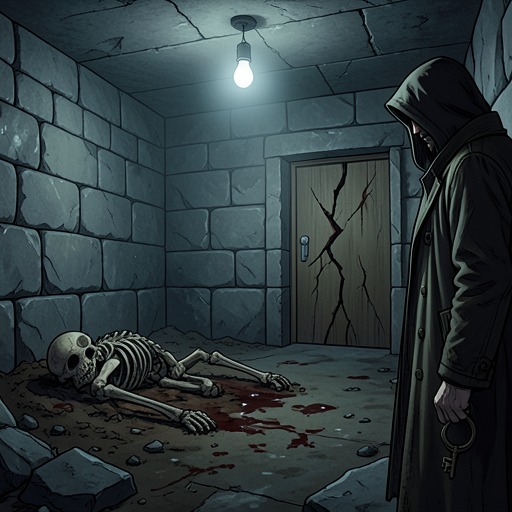
Vic and Quilla June reach the surface after escaping the underground world, but freedom immediately becomes a problem of competing obligations. Blood is waiting near the access dropshaft, weak, hungry, and badly wounded. He has not eaten properly, has survived on a lizard, and cannot rise when Vic tries to lift him. Blood also warns that the underground inhabitants know the fugitives are alive and that the pair cannot safely return to the city. The escape therefore offers no simple refuge: the fugitives are exposed, the city is hostile, and Blood requires food and medical care at once.
Quilla June sees the danger differently. She urges Vic to hurry because the people below may come up through the dropshaft. Her fear is concrete, but her solution requires leaving Blood where he lies. When she adds, “If you love me, you’ll come on!”, she turns the question of love into a direct demand for proof. The sentence makes the choice measurable: Vic must either follow the woman who has escaped with him or remain with the injured animal whose condition makes delay dangerous.
Blood as the Counterweight to Romance
The abandonment of Quilla June cannot be understood apart from Vic’s earlier relation to Blood. Before the underground episode, Vic treats the dog with rough mockery and uses him as a companion in a violent, resource-starved world. Blood hunts for food, speaks through their established animal telepathy, and remains beside Vic during his movements through the ruined city. Vic’s language toward him is often obscene or hostile, but the hostility is part of an intimate bond rather than evidence of indifference.
Blood’s vulnerability changes the emotional meaning of that bond. When Vic lifts his head and Blood softly says, “Hey,” Vic experiences the reunion as a profound relief. Blood has waited for him despite weakness and injury. Vic tries to devise a practical rescue: he proposes going into the city for food and returning quickly, while Blood warns that the city is marked against them. Their problem is not abstract affection but interdependence. Vic knows that he cannot survive without Blood, and Blood’s physical condition makes the choice urgent rather than symbolic.
The contrast is sharpened by the different forms of intimacy surrounding Vic. His first encounter with Quilla June begins in sexual violence, but her frightened face unexpectedly unsettles him. He notices her features, feels discomfort at her fear, and briefly wants to reassure her even while intending to rape her. Later, she confesses that she loves him and asks whether the underground world is really as dirty as her Poppa says. Their relationship thus develops from coercion into mutual attachment, but it remains entangled with fear, manipulation, and the material pressures of escape.
Love as a Test Rather Than a Promise
Quilla June’s question, “Have you ever been in love?”, becomes the conceptual center of the later decision. Vic initially does not understand what she means, requiring her to clarify that she is asking about love for a girl. After their reunion, she declares her love and asks him to leave with her, even while acknowledging that escaping may require him to hurt her Poppa. Vic responds to this invitation and believes he wants her; he even embraces and kisses her when she returns in tears, telling her that everything is all right.
At the dropshaft, however, the emotional claim of romantic love collides with the physical fact of Blood’s wounds. Vic cannot make it alone across the wasteland, and he knows that Blood needs immediate nourishment and care. Quilla June’s insistence that he prove his love by leaving Blood transforms her appeal into a demand that excludes the very relationship on which Vic’s survival depends. The decision is therefore not simply that Vic prefers a dog to a woman. It is that Quilla June defines love as exclusive possession, while Vic discovers that his own understanding of love includes responsibility to a dependent companion.
The scene produces a sharp value reversal. The escape begins as a movement toward shared freedom with Quilla June, but her demand makes that freedom morally and practically unacceptable. Vic’s attachment to her weakens precisely when she asks him to demonstrate it, while his commitment to Blood intensifies as Blood becomes helpless. The romantic promise does not culminate in a reunion or a secure partnership; it breaks against the obligation created by injury.
The Decision and Its Immediate Consequences
Vic stays with Blood. He makes a small fire, carefully kept low enough that no roverpak can see it from the city’s outskirts, and gives Blood food until the dog has eaten his fill. He then carries Blood to an air duct a mile away, where they spend the night on a narrow ledge. Vic holds him throughout the night, and in the morning treats his wounds well enough for Blood to survive. Blood eats again from the remaining food, while Vic has no appetite.
This sequence shows that Vic’s choice is enacted through labor rather than declaration. He does not merely refuse Quilla June’s demand; he feeds Blood, transports him, shelters him, and repairs his injuries. The practical actions give bodily form to the bond that Vic has struggled to name. Quilla June disappears from the immediate scene, while Blood receives the attention and care that her ultimatum would have denied him.
The consequence is also a renewed journey. Vic, Blood, and the absent possibility of Quilla June cannot return to the city, and they cannot simply proceed at full speed because Blood is still limping. They set out across the blasted wasteland to find another city. The escape has become an uncertain migration, but it is undertaken with the relationship Vic has chosen to preserve.
Narrative Significance and Ending
The abandonment gives the book’s final definition of love its force. For much of Vic’s life, sexuality is treated as appetite and exchange: he asks Blood to find him a sexual opportunity, while food and other scarce goods regulate movement through the ruined social order. The underground city likewise presents a highly managed society in which politeness, reproduction, and social belonging are organized by communal rules. Against these systems, Quilla June’s language makes love into a claim that must be proved through immediate sacrifice.
Vic’s answer is not an abstract moral conversion. He remains the same hard, violent survivor who can threaten, insult, and pursue his objectives brutally. Yet the sight of Blood’s weakness compels a different kind of action from him. Earlier, Blood’s warnings about the underground people are dismissed with contempt; now Blood’s hunger and inability to stand become impossible for Vic to ignore. The relationship survives not because Vic becomes gentle in general, but because loyalty to this particular companion overrides the logic of abandonment.
As Vic crosses the wasteland with Blood, he continues to hear Quilla June’s question in his mind: “Do you know what love is?” His final answer is brief and categorical: “A boy loves his dog.” The line closes the action by converting a failed romantic escape into a definition grounded in care, endurance, and reciprocal dependence. Vic abandons Quilla June, but the ending presents that abandonment as the decision through which he finally recognizes what love means to him.